Project linksTensor nets
Quantum-inspired Collatz algorithm
Thesis research on a quantum-inspired approach to the Collatz conjecture.
quantum algorithmstensor networkstheory
Research
Algorithms and tooling for quantum information processing, from tensor-network search methods to photonic/fermionic simulators and hardware-aware runtimes for near-term devices.
Operator- and tensor-network framing for structured search, paired with reproducible simulator maintenance (Piquasso, ffsim) and hardware-aware runtime/mitigation work for community challenges.
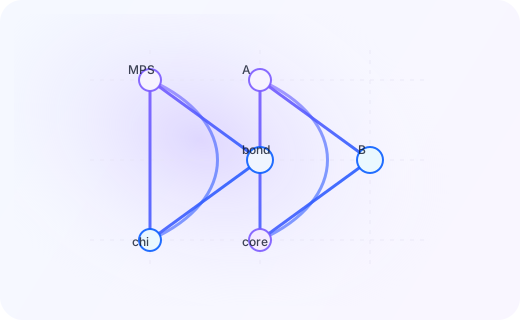
My HKUST Physics MPhil with Prof. Adrian Po (Jan 2024–Aug 2025) reframes Collatz trajectories as operator and tensor-network objects to study structured search. In parallel, I maintain photonic and fermionic simulators (Piquasso, ffsim) with reproducibility checklists and hardware-aware benchmarks.
This track also includes hardware-aware runtime and mitigation work—from IBM Quantum Challenge authoring to open-source contributions—so that structured-search ideas stay grounded in device realities.
Thesis research on a quantum-inspired approach to the Collatz conjecture.
Maintainer for Piquasso, covering Gaussian, Fock, and boson-sampling backends.
Contributing to ffsim starting Jul 2025.
Shipped the IBM Quantum Fall Challenge 2022 and supporting solution harness.
Contributor implementing and validating ZNE, CDR, and PEC pipelines with cross-backend tests.
Mentoring-project work to prototype TREX simulations using backend noise models.
Designed simultaneous randomized benchmarking sequences to measure crosstalk resilience.
Maintaining the H-hat quantum language project and ecosystem efforts.
Top-20 proposal exploring qudit support and entanglement structure in Qiskit.
MPhil Thesis, Department of Physics, HKUST
NANO KOREA 2022 Symposium