Skip to content

Research

Quantum information, quantum matter, and science for AI

Research stack: quantum information & computation (tensorized algorithms and simulators), quantum matter, control, and simulation, and science-for-AI evaluations.

Spotlighting 3 strategic areas.

Focus areas

3

Strategic areas

Projects

12

Research initiatives and tools

Publications

3

Relevant publications

Research
Area 1

Quantum information & computation

Quantum information

Algorithms and tooling for quantum information processing, from tensor-network search methods to photonic/fermionic simulators and hardware-aware runtimes for near-term devices.

Operator- and tensor-network framing for structured search, paired with reproducible simulator maintenance (Piquasso, ffsim) and hardware-aware runtime/mitigation work for community challenges.

Key results3
  • Mapped Collatz trajectories into tensor-network operators to study search structure.
  • Aligned tensor-network heuristics across photonic and fermionic stacks with upstream maintainers.
  • Co-authored hardware-aware challenge tracks and mitigation workflows used by 3k+ participants.
Ongoing projects2
  • Finalizing the Oct 2025 thesis and releasing structured-search visualizations.
  • Benchmarking tensor-network paths and runtime costs across simulators.
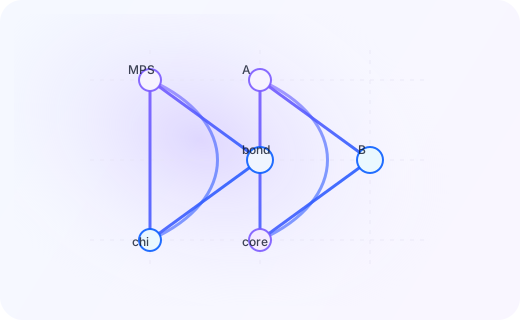
Tensor network contraction grid highlighting bonds
Summary
Research
Area 2

Quantum matter, control, and simulation

Quantum matter & control

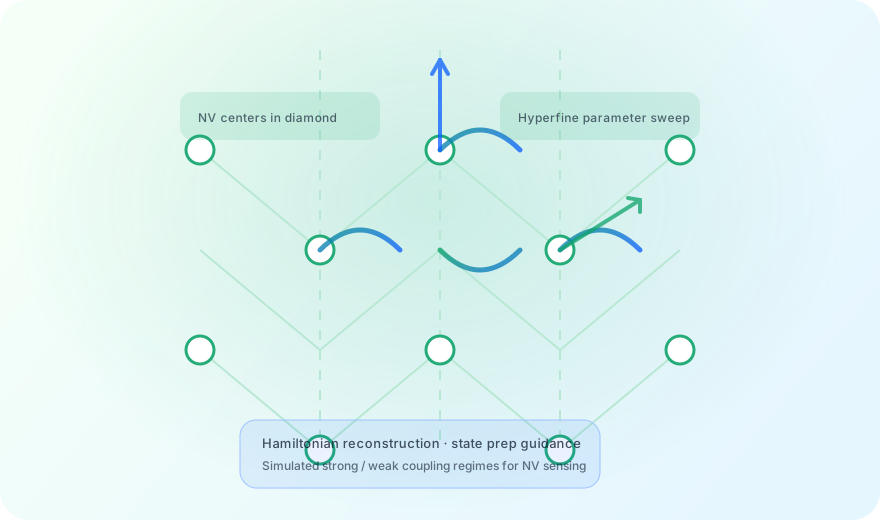
Quantum many-body systems, sensing, and neutral-atom control, linking NV-center metrology, dipolar gases, and Rydberg platforms to practical calibration and control tooling.

Fit interacting systems and deliver control stacks across NV centers, dipolar gases, and neutral-atom arrays; focus on turning sensing traces and calibration data into reliable control and visualization.

Key results3
  • Recovered NV-center hyperfine parameters used in subsequent state-preparation studies.
  • Shared dipolar BEC results at APS DAMOP 2020.
  • Delivered Strontium-88 Rydberg control middleware with HKUST collaborators.
Ongoing projects1
  • Extending sensing fits to speed up calibration cycles.
NV-center and neutral-atom control diagram
Summary
Research
Area 3

Science for AI

Science for AI

Performance- and hardware-efficient AI, building tools that make models faster, leaner, and more reliable on real-world compute.

Focuses on the interface between algorithms and hardware: profiling, evaluation, and optimization workflows that surface bottlenecks, guide model and runtime choices, and make advanced AI systems practical on constrained devices.

Key results3
  • Built internal prototypes for invariance- and conservation-based evaluations (pre-publication).
  • Defined a release plan for sharable stress-harness notebooks and datasets.
  • Aligned metrics with physical priors to interpret model behavior and uncertainty.
Ongoing projects1
  • Publishing the first science-for-AI research notes and benchmark slices in 2025.